How rare is your car? Built on open registration data

2002 Mercedes-Benz SL-Class: how many are left, MOT pass rate and mileage

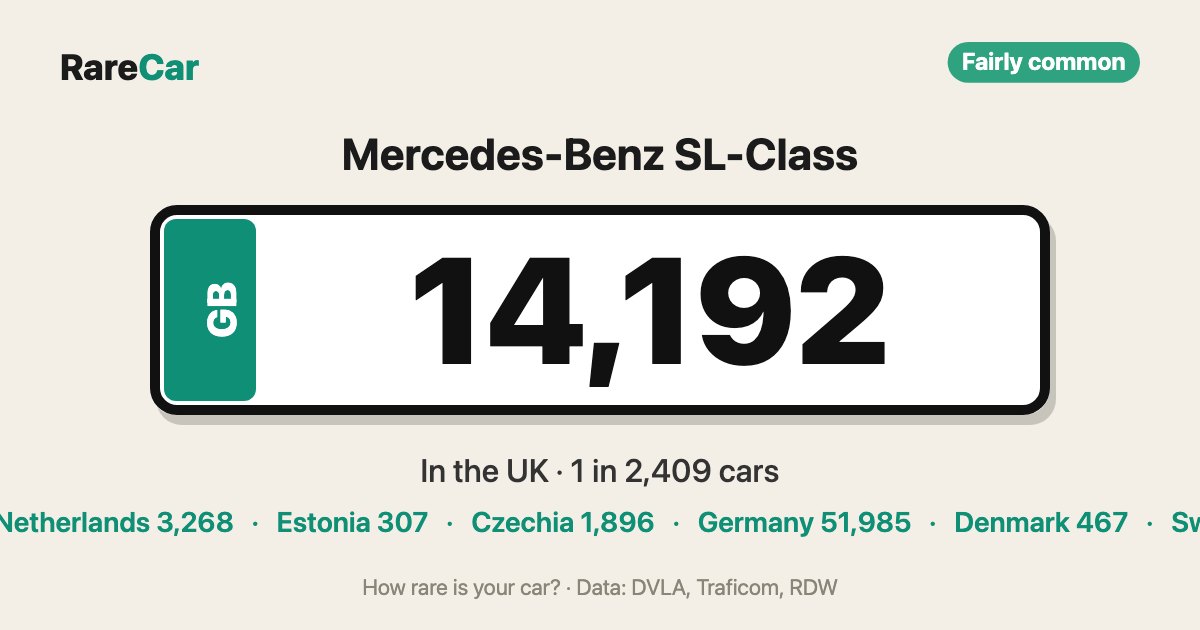
2002 Mercedes-Benz SL-Class cars failed their 2025 MOT less than half as often as other cars of the same age (20% vs 40%). There are 532 of them licensed, one in every 64,252 cars (DVLA). Typical mileage at the MOT is about 74,000 miles, and half of the cars show 54,000–94,000 miles. The most common failure item was suspension arms: 6.1 per 100 tests, about as often as the average car.

Mercedes-Benz SL-Class
Illustrative photo of the model; the model year may differ. Photo: Alexander-93 · CC BY-SA 4.0 · Wikimedia Commons
Licensed in the UK
532
1 in 64,252 cars
MOT fail rate 2025
19.6%
same-age cars 40.5%
Typical mileage
74k miles
half between 54k and 94k miles
Age
23 yrs
first used 2002
Failure rate by year
SL-ClassAll cars
20020%20%40%60%1990200020102020All cars 1985: 23.8%All cars 1986: 26.3%All cars 1987: 25.6%All cars 1988: 26.3%All cars 1989: 26.6%All cars 1990: 27.2%All cars 1991: 28.1%All cars 1992: 31.1%All cars 1993: 31.4%All cars 1994: 31.3%All cars 1995: 32.9%All cars 1996: 33.4%All cars 1997: 33.7%All cars 1998: 35.0%All cars 1999: 35.8%All cars 2000: 37.7%All cars 2001: 39.0%All cars 2002: 40.5%All cars 2003: 41.4%All cars 2004: 42.4%All cars 2005: 42.5%All cars 2006: 43.1%All cars 2007: 42.7%All cars 2008: 43.0%All cars 2009: 41.9%All cars 2010: 40.9%All cars 2011: 38.9%All cars 2012: 36.7%All cars 2013: 34.4%All cars 2014: 31.4%All cars 2015: 28.2%All cars 2016: 25.1%All cars 2017: 21.8%All cars 2018: 19.1%All cars 2019: 16.5%All cars 2020: 14.0%SL-Class 1985: 21.2%SL-Class 1986: 19.6%SL-Class 1987: 19.6%SL-Class 1988: 14.2%SL-Class 1989: 14.1%SL-Class 1991: 23.0%SL-Class 1992: 16.7%SL-Class 1993: 24.2%SL-Class 1994: 20.4%SL-Class 1995: 20.2%SL-Class 1996: 21.1%SL-Class 1997: 19.2%SL-Class 1998: 21.2%SL-Class 1999: 18.4%SL-Class 2000: 18.7%SL-Class 2001: 16.6%SL-Class 2002: 19.6%SL-Class 2003: 18.7%SL-Class 2004: 17.2%SL-Class 2005: 18.1%SL-Class 2006: 17.9%SL-Class 2007: 18.8%SL-Class 2008: 15.9%SL-Class 2009: 19.2%SL-Class 2010: 20.2%SL-Class 2011: 15.3%SL-Class 2012: 16.4%SL-Class 2013: 19.0%SL-Class 2014: 14.5%SL-Class 2015: 13.3%SL-Class 2016: 10.8%SL-Class 2017: 7.5%SL-Class 2018: 9.4%SL-Class 2019: 8.9%SL-Class 2020: 8.6%19.6%
Mileage: middle half and median
SL-Class 2002: 74k milesAll cars 2002: 102k miles
074k miles113k miles

Most common MOT failure: suspension arms

Failure items per 100 MOT tests in 2025, compared with all cars first used in 2002. One car can have several failure items.

SL-ClassAll cars
Suspension arms · Suspension
6.1
6.5
Condition · Tyres
5.0
4.7
Brake performance · Brakes
3.5
11.0
Headlamp aim · Lamps, reflectors and electrical equipment
2.4
8.8
Shock absorbers · Suspension
2.3
1.9
Exhaust emissions · Noise, emissions and leaks
2.2
8.8
Show as table
Item/ 100 testsAverageRatio
Suspension arms · Suspension6.16.50.9×
Condition · Tyres5.04.71.1×
Brake performance · Brakes3.511.00.3×
Headlamp aim · Lamps, reflectors and electrical equipment2.48.80.3×
Shock absorbers · Suspension2.31.91.2×
Exhaust emissions · Noise, emissions and leaks2.28.80.2×

Country comparison, 2002 models

Cars per 100,000 registered cars.

🇬🇧 United Kingdom31 Dec 2025
532 cars · 1.6 per 100,000
🇫🇮 Finland30 Sep 2026
74 cars · 2.7 per 100,000
🇳🇱 Netherlands15 Nov 2026
609 cars · 6.0 per 100,000
🇪🇪 Estonia1 Nov 2026
32 cars · 4.7 per 100,000
🇨🇿 Czechia1 Nov 2026
192 cars · 2.8 per 100,000
🇩🇪 Germany1 Jan 2026
no year data
🇩🇰 Denmark15 Nov 2026
59 cars · 2.0 per 100,000
🇨🇭 Switzerland31 Oct 2026
440 cars · 9.0 per 100,000

Selling this car?

Enter your car's mileage to get ready-made text for your advert showing how your car compares.

Copy the text and paste it into your advert.

Check how rare your own car is →

← 2001 · All years · 2003 →

All cars from 2002 →

Cite this page

You may use the figures and charts freely with a credit and a link to this page.

Source: RareCar (DVLA/DVSA data), 31 Dec 2025. https://rarecar.eu/uk/cars/mercedes-benz/sl-class/2002/
Download share image

Terms and open data